Cracking the Code: A Parent's Complete Guide to Factors, Multiples & the Singapore Math Advantage
From the 1–100 number board to tricky remainder word problems — everything your child needs to master one of primary school's most foundational topics, explained clearly for parents and students alike.
Here's the thing about primary school mathematics in Singapore — it doesn't just teach children how to calculate. It teaches them how to think. And nowhere is that more evident than in the deceptively simple world of factors and multiples.
You might remember these from your own school days — perhaps as a list of numbers scribbled on the back of a notebook. But for today's P4 to P6 students, factors and multiples are the gateway to some of the most powerful mathematical reasoning they'll ever encounter. Miss this foundation, and the cracks show up everywhere: in fractions, in ratio, in algebra, and beyond.
Think of a number like a house. The factors are the keys that open it — only certain numbers divide in cleanly, with nothing left over. The multiples, on the other hand, are every house that this number can unlock as a key. Same relationship, two different lenses.
F Factors — The Keys That Fit
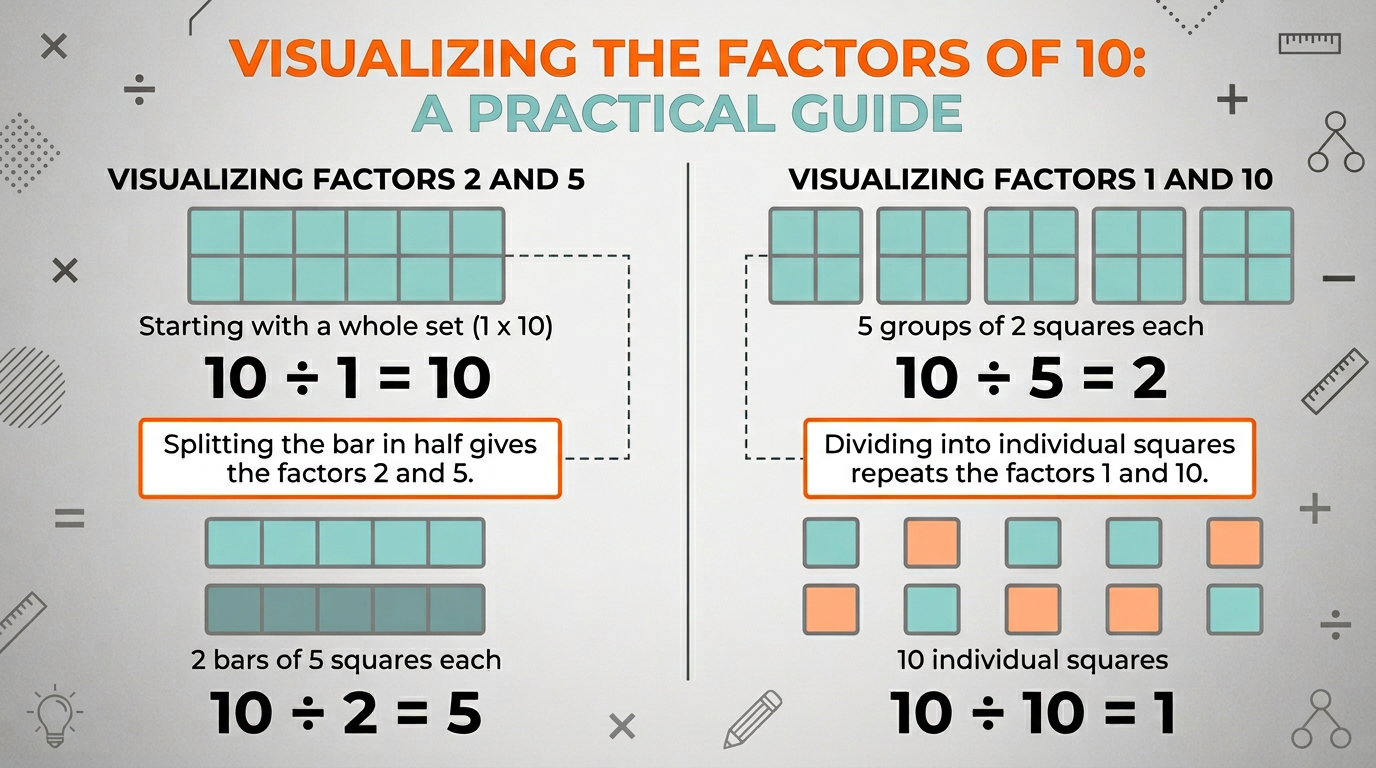
The factors of a number are the whole numbers that divide into it exactly — no remainders, no loose ends.
1 × 12 = 12 ✅
2 × 6 = 12 ✅
3 × 4 = 12 ✅
∴ Factors = { 1, 2, 3, 4, 6, 12 }
Always finite — every number has a fixed set.
M Multiples — The Infinite March
Multiples of a number are what you get when you multiply it by any whole number. They go on forever.
6 × 1 = 6
6 × 2 = 12
6 × 3 = 18
6 × 4 = 24 … ∞
Always infinite — they never stop.
↔ The Elegant Relationship
If x is a factor of y, then y is a multiple of x. Two sides of the same coin.
↕
12 is a multiple of 3
Chain: 3 → 12 → 24 → 36…
factor → number → multiples
If there's one tool every parent should print out and stick on the fridge, it's the 1–100 number board. It transforms abstract number relationships into something you can see — and seeing, as any experienced educator will tell you, is the first step to believing.
1 Anatomy of Factors on the Board
Factors always appear to the left of or on the number itself — they're the smaller companions hiding inside every number.
| Number | Factors on Board |
|---|---|
| 12 | 1, 2, 3, 4, 6, 12 |
| 24 | 1, 2, 3, 4, 6, 8, 12, 24 |
| 36 | 1, 2, 3, 4, 6, 9, 12, 18, 36 |
2 Anatomy of Multiples on the Board
Multiples march forward in equal steps, forming strikingly beautiful visual patterns across the board.
| Multiples of… | Visual Pattern |
|---|---|
| 2 | Perfect vertical stripes (all even columns) |
| 5 | Two neat columns — ends in 0 or 5 |
| 3 | Beautiful diagonal staircase |
| 9 | Steep diagonal; digit sum always = 9 |
| 10 | Entire last column: 10, 20, 30…100 |
3 The Colour-Coding Strategy 🎨
Grab two coloured pens and watch LCM reveal itself visually — no formula required.
| Colour | Meaning |
|---|---|
| 🔵 Blue | Multiples of 3 |
| 🔴 Red | Multiples of 4 |
| 🟣 Purple | Numbers that are both → LCM! |
Here's the kind of problem that separates students who understand factors and multiples from those who merely memorise rules. Work through it with your child — the thinking process is as valuable as the answer.
📖 Kai's Marble Problem
Kai has fewer than 50 marbles in his tin box.
When he arranges them equally into groups of 6, he has 3 marbles left over.
When he arranges them equally into groups of 7, he is short of 4 marbles to complete the next group.
How many marbles does Kai have?
📖 Translating the Clues
| Clue | Mathematical Meaning |
|---|---|
| Fewer than 50 marbles | Answer < 50 |
| Groups of 6, left with 3 | Remainder = 3 when divided by 6 |
| Groups of 7, needs 4 more | Remainder = 7 − 4 = 3 when divided by 7 |
6×4+3 = 27 6×5+3 = 33 6×6+3 = 39
6×7+3 = 45 6×8+3 = 51 ❌ (exceeds 50)
✅ Candidates: { 9, 15, 21, 27, 33, 39, 45 }
7×4+3 = 31 7×5+3 = 38 7×6+3 = 45
7×7+3 = 52 ❌ (exceeds 50)
✅ Candidates: { 10, 17, 24, 31, 38, 45 }
From ÷7 list: { 10, 17, 24, 31, 38, 45 }
🏆 Answer: Kai has 45 marbles.
Remainder = Group Size − Amount Needed = 7 − 4 = 3 ✅
Factors and multiples look deceptively simple on the surface. But the misconceptions children develop here have a penchant for lingering well into secondary school if left unaddressed. Here are the most common stumbling blocks — and practical strategies to overcome each one.
⚠️ Confusing Factors with Multiples
Children mix up the direction. Anchor it with a simple image: factors are smaller (they fit inside), multiples are larger (they extend outward).
Fix: The factor rainbow activity — the visual direction of "inward" versus "outward" reinforces the concept physically.
⚠️ Incomplete Factor Lists
Students frequently miss factor pairs, especially for larger numbers like 48 or 60.
Fix: Teach them to always work in pairs and stop when the two numbers in a pair meet or cross. For 36, once they reach 6 × 6, they know they're done.
⚠️ Misreading Remainder Language
Phrases like "short of 4" or "needs 3 more" require translation into mathematical remainders — a language problem as much as a maths problem.
Fix: Practise this translation skill explicitly. Write the formula on a card: Remainder = Group Size − Amount Needed.
Practical Strategies for Parents at Home
- Play the Frog Jump game during car rides — no board needed, just mental multiples. "Let's count in 7s to 70!"
- Use egg cartons to physically arrange objects into groups and explore remainders. 13 eggs in a 6-egg carton — how many left over?
- Cook together: "If we have 24 cookies and want equal groups, what group sizes work?" — that's factoring in disguise.
- Celebrate systematic listing, not just the correct answer. The habit of exhaustive, ordered thinking is the real prize.
- Use the number board as a dinner table conversation piece — point to a number and ask: "Name three factors of that number."
Singapore's mathematics curriculum has its roots in a 1980s reform movement that fundamentally rejected rote learning in favour of conceptual mastery. The result? Singapore students consistently rank among the world's top performers in TIMSS and PISA assessments.
Concrete → Pictorial → Abstract (CPA)
Children first manipulate physical objects (counters, tiles, egg cartons), then work with visual representations (number boards, bar models), and only then move to abstract notation. Factors and multiples are introduced through grouping activities long before the formal vocabulary arrives. This sequencing isn't accidental — it mirrors how the human brain builds mathematical understanding.
The Bar Model Method
Singapore's signature visual tool adapts beautifully to factor and multiple problems. A bar divided into equal sections makes the concept of "divides exactly" tangible and intuitive. When students draw a bar of 24 divided into equal groups of 6, they see that 6 is a factor — no memorisation required.
Spiral Curriculum — Topics That Deepen Over Time
Topics aren't taught once and abandoned. Factors appear in P4, deepen in P5 with LCM and HCF, and resurface in P6 within fraction and ratio problems. Each encounter builds on the last. A student who understands that 12 is a multiple of 3 because 3 × 4 = 12 will never confuse the two concepts — regardless of how the question is phrased.
Teaching for Mastery — No Child Left Behind a Concept
Singapore's curriculum insists that children understand why before they learn how. If a student cannot explain why 7 is not a factor of 30, they haven't mastered the concept — they've only memorised a procedure. Teachers are trained to identify and address misconceptions before moving forward, a practice parents can replicate at home.
How Factors & Multiples Are Assessed in Singapore Schools
P4 — Introduction
- Listing factors and multiples of numbers up to 100
- Identifying common factors and common multiples
- Simple word problems involving grouping and remainder logic
P5 — LCM and HCF
- Finding the Lowest Common Multiple (LC