The Mightiest Shape in Geomety: Triangles
From the trusses holding up your HDB roof to the GPS guiding your next Grab ride — discover why mastering triangles is one of the most powerful things your child can do in primary school mathematics.
📋 What You'll Learn in This Guide
Why the Triangle Is the Most Important Shape Your Child Will Ever Study
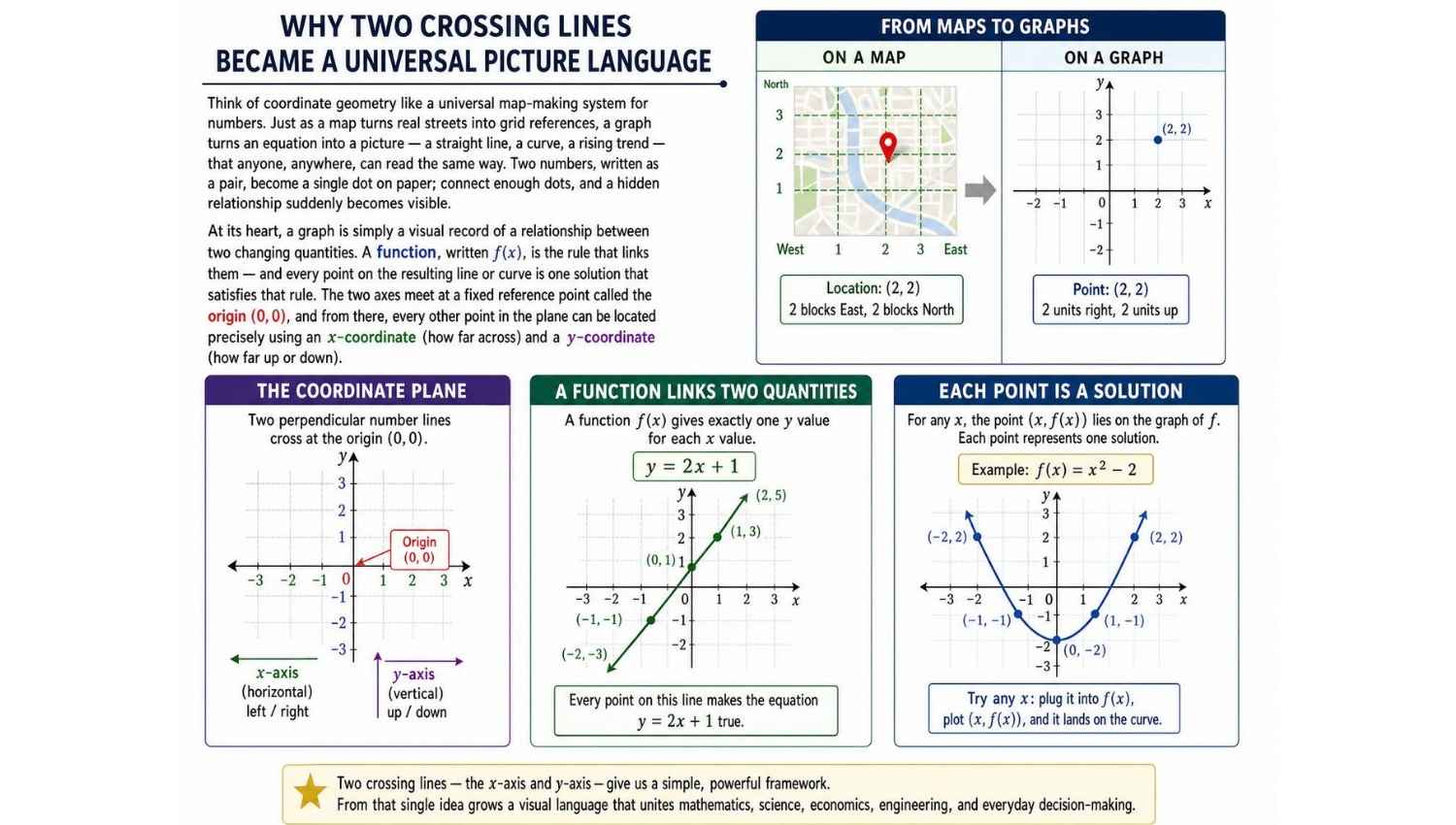
Look up at the roof of your HDB block. Peer at an electricity pylon along the expressway. Examine the steel frame of the Esplanade. What do you see repeated, almost obsessively, everywhere? Triangles. This is not a coincidence — and it is certainly not just art.
The triangle is the simplest polygon — a flat, closed shape with just three sides and three corners. Yet it is also the only polygon that is naturally rigid. Push on one side of a square and it collapses into a parallelogram. Push on a triangle and it holds its shape perfectly. Engineers have known this for centuries. It is time for your child to discover it too.
Flat with 3 Sides: The Four Triangles Your Child Must Know
Think of a triangle like a three-legged stool. Just as three legs always find a stable position on any uneven floor — while a four-legged chair wobbles — a triangle's three sides lock each other into a form that cannot flex or distort. This is precisely why triangles are ubiquitous in construction and engineering.
A triangle is defined by two things: the lengths of its three sides and the sizes of its three angles at the vertices. One rule never breaks: the three interior angles of any triangle always add up to exactly 180°. Always. No exceptions.
Equilateral Triangle
When all three sides are equal in length, the triangle is equilateral. Because all sides match, all three angles are also equal — each measuring exactly 60°, since 60 × 3 = 180°. It is the most symmetrical triangle of all.
Isosceles Triangle
When exactly two sides share the same length, the triangle is isosceles. The two angles opposite the equal sides — called the base angles — are also equal. This symmetry is the key property students must recognise quickly in exams.
Scalene Triangle
When all three sides are different lengths, the triangle is scalene. All three angles are different too. There is no symmetry here — every element is unique, which makes it the trickiest type to work with when finding missing angles.
Right-Angled Triangle
Any triangle with one angle equal to exactly 90° is right-angled. It can also be isosceles or scalene. This triangle is the foundation of Pythagoras' theorem in secondary school — and it appears in nearly every PSLE geometry question.
From 2D Shape to 3D Thinking: A Real PSLE-Style Challenge
Singapore's curriculum pushes students to apply 3D perspective even to basic 2D shapes — to see beyond the obvious and reason about relationships between figures. Here is a problem that has tripped up even the sharpest P6 minds. Work through it with your child. The insight it teaches is worth far more than the marks it carries.
The Overlapping Triangles Problem
A classic multi-step geometry problem — the kind that separates good students from great ones.
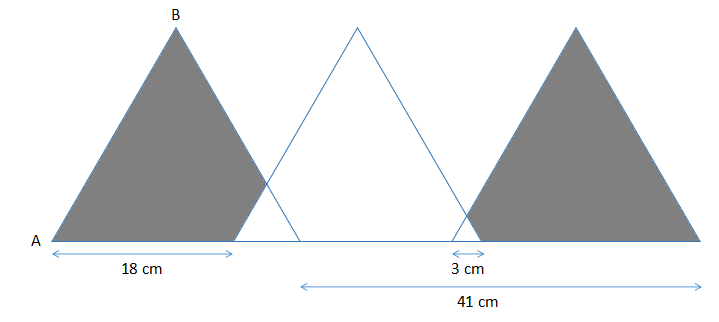
Three identical equilateral triangles — labelled A, B, and C — are placed in a row.
• Triangle A overlaps Triangle B.
• Triangle B overlaps Triangle C by 3 cm.
• The distance from the left edge of Triangle A to the overlap point between Triangle B and C
is 18 cm.
• The total length from the left edge of Triangle A to the right edge of Triangle C
is 41 cm.
Find the side length of each equilateral triangle.
🧠 The 3D Visualisation Technique — The Key That Unlocks This Problem
Here is the insight that separates students who get this right from those who do not. Imagine looking at the three triangles from directly above — a bird's-eye view. When two identical lengths overlap each other, the total visible span shrinks by exactly the amount that is hidden. Think of it like two identical rulers sliding over each other: the more they overlap, the shorter the combined length appears. The hidden portion does not disappear — it is simply concealed beneath the shape on top.
- Fully overlapped: you see only one shape — the hidden portion is 100% concealed.
- Not overlapped at all: every edge is fully visible — nothing is hidden.
- Partially overlapped: the visible length is shorter by exactly the same overlap amount — and that amount must be added back to recover the full side length.
- Two equal lines Partially overlapped: the non-overlapped length is always identical.
📖 Step-by-Step Solution
The 18 cm covers from the left edge of Triangle A to the point where Triangles B and C begin to overlap. The remaining distance — from that overlap point to the right edge of Triangle C — is:
= 41 cm − 18 cm
= 23 cm
The 23 cm is the visible portion of Triangle C's base — measured from the overlap point to its right edge. But here is the crucial detail: this measurement excludes the 3 cm that is hidden beneath Triangle B's overlap. The full side of Triangle C is longer than what the eye can see.
Since the 3 cm overlap was not included in the 23 cm visible portion, we add it back to recover the full, unobstructed side length of the triangle:
= 23 cm + 3 cm
= 26 cm
Common Obstacles Children Face — And What Parents Can Do About Them
Even bright, hardworking students stumble on triangle problems. Understanding why they stumble is half the battle. The other half is knowing exactly how to intervene — early, calmly, and effectively.
⚠️ Confusing Triangle Types
Students memorise names without understanding the properties behind them. When a question uses an unfamiliar diagram, the names become useless.
⚠️ Forgetting the 180° Rule
Children recall the rule in isolation but forget to apply it when finding missing angles in multi-step problems.
⚠️ Stopping at the Visible Length
In overlap problems, students report the visible portion as the final answer without restoring the hidden overlap — the single most common error in this topic.
⚠️ Skipping the Diagram Label Step
Students rush to calculate without marking equal sides, angles, or unknowns on the diagram. They lose track of what they know and what they are solving for.
How Triangle Thinking Shows Up in the Real World
The 3D top-view technique used to solve the overlapping triangles problem is not just a test strategy. It is a fundamental way of thinking that appears throughout science, technology, engineering, art, and daily life. Your child is not just learning geometry — they are learning how to see the world more clearly.
🏗️ Architecture & Construction
Architects use top-down plan views and side-on elevation drawings to design every building in Singapore. Understanding how a 3D structure looks from different angles is a skill that has its roots in simple overlap problems in primary school. The next time you walk past a construction site, point out the triangular trusses to your child.
📡 GPS & Navigation
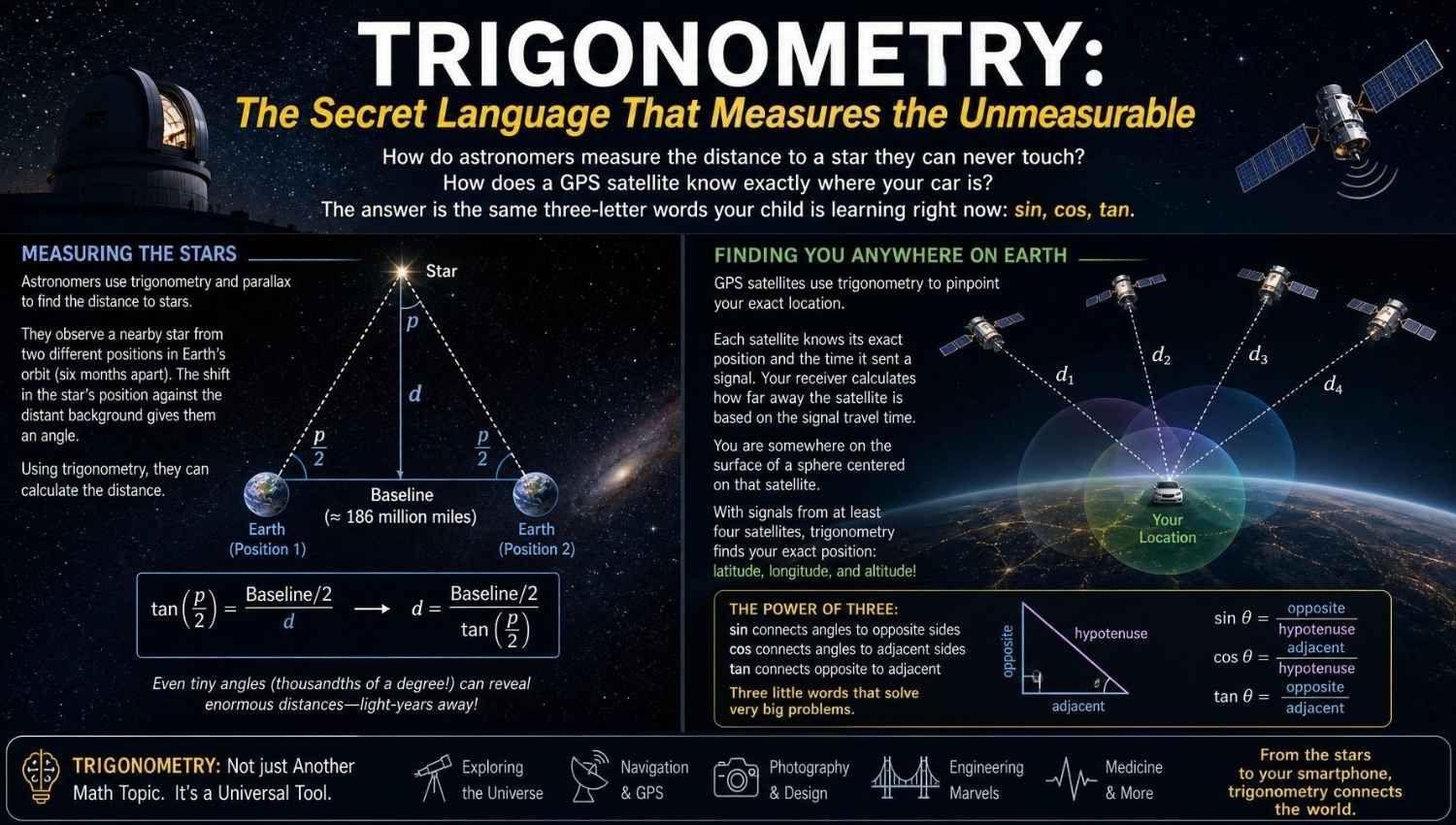
The GPS system in your family's car relies on triangulation — measuring distances from three satellites to pinpoint your exact location on Earth. Your child's triangle knowledge is, quite literally, guiding your next Grab ride. That is not a metaphor. That is applied mathematics.
🎮 Technology & Gaming
Every 3D image in a video game or animated film is built from millions of tiny triangles called polygons. The smoother a surface looks, the more triangles the computer has used to render it. Triangle geometry is the language of the digital world — and it is ubiquitous in every screen your child looks at.
🔬 Engineering & Science
Triangular trusses in bridges, pylons, and roof structures distribute weight efficiently because of the triangle's inherent rigidity. Students who understand why triangles are rigid — not just that they are — are already thinking like engineers. That instinct, developed early, has deleterious effects on mediocrity and a penchant for producing exceptional problem-solvers.
🎨 Art & Design
The Esplanade's iconic shell is composed of thousands of triangular aluminium sunshades, each one calculated to block direct sunlight while admitting diffuse light. Peranakan tiles frequently feature geometric patterns built from interlocking triangles. Spatial thinking and artistic creativity share the same mathematical roots — and they always have.
🗺️ Surveying & Mapping
Before GPS, surveyors used triangulation to map entire countries — including Singapore. The 180° angle sum rule was their most trusted instrument. It remains the foundation of modern geospatial technology today. Every map your child has ever used was built, at some level, on triangle geometry.
Start Today: Your Child's Triangle Journey Begins at Home
You do not need to be a mathematician to help your child master triangles. You need curiosity, patience, and the willingness to ask one simple question on your next walk to the MRT: "What kind of triangle is that?" That question, asked consistently, is worth more than a dozen worksheets.
🎯 Your Action Plan This Week
Five activities. None require more than fifteen minutes. All of them work.
- Print a triangle reference card — equilateral, isosceles, scalene, right-angled — with a small diagram and key property for each. Stick it on the fridge. Passive exposure is surprisingly effective.
- Do the paper-tearing proof together — tear off all three corners of any triangle and line them up to show 180°. Let your child do the tearing. Ownership of the discovery makes it memorable.
- Try the ruler overlap game — two identical rulers, a 3 cm overlap. Measure the visible total. Ask: "What is the full length of one ruler?" Work through it together before revealing the answer.
- Walk around your estate and photograph five triangles — then classify each one together at home. Bonus points for finding a right-angled triangle in a real building structure.
- Work through the overlapping triangles problem in this article with your child — step by step, no rushing. If they get it right, ask them to explain each step back to you. If they get it wrong, celebrate the mistake and find the step where the thinking went astray.