Trigonometry: The Secret Language That Measures the Unmeasurable
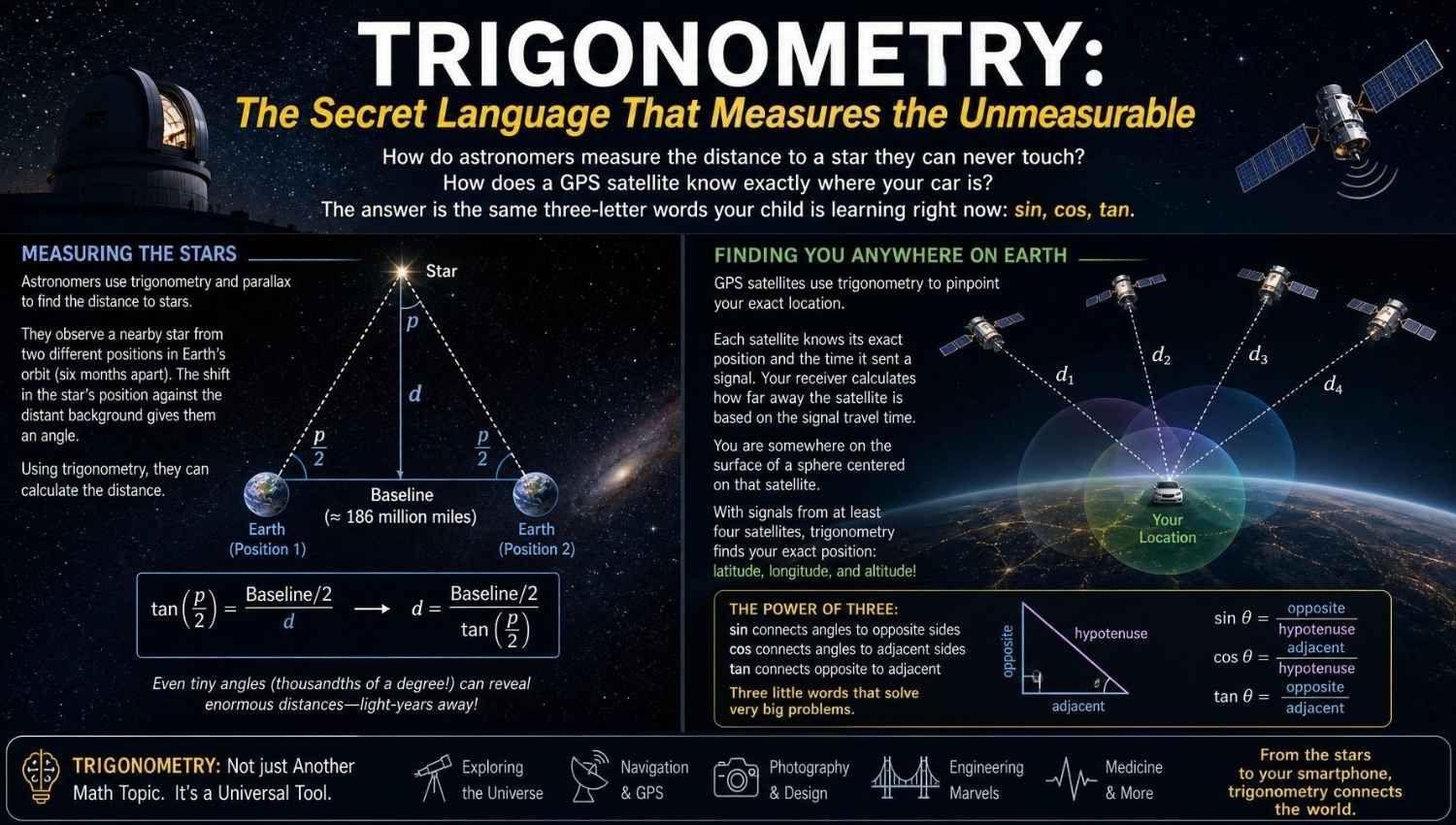
How do astronomers measure the distance to a star they can never touch? How does a GPS satellite know exactly where your car is? The answer is the same three-letter words your child is learning right now: sin, cos, tan.
📋 What You'll Learn in This Guide
Why a Simple Ratio Became One of Humanity's Greatest Tools
Think of trigonometry like a universal translator between angles and lengths. Just as a translator lets you understand a language you've never spoken, trigonometry lets you calculate a distance you can never directly measure — the height of a flagpole, the width of a river, the distance to a star — simply by knowing one angle and one side.
At its heart, trigonometry is built on a beautifully simple idea: in a right-angled triangle, the relationship between the angles and the side lengths never changes, no matter how big or small the triangle is. A tiny paper triangle and a giant triangle drawn across a football field, if they share the same angles, will always share the exact same ratios between their sides. This one fact — called similarity — is the seed from which the entire subject grows.
The Anatomy of a Trigonometric Ratio
Every right-angled triangle has three sides, but only one keeps its name no matter which angle you pick: the hypotenuse — always the longest side, always opposite the right angle. The other two sides swap names depending on which angle you focus on.
Hypotenuse
The longest side, always found directly across from the 90° angle. It never changes name.
Opposite Side
The side directly across from the chosen angle. Change the angle, and this side changes too.
Adjacent Side
The side that touches the chosen angle but is not the hypotenuse.
The Three Ratios
Sine, cosine, and tangent each link two particular sides to the chosen angle.
CAH → Cos(angle) = Adjacent ÷ Hypotenuse
TOA → Tan(angle) = Opposite ÷ Adjacent
Because the two non-right angles in any right-angled triangle always add up to 90°, sin(angle) = cos(90° − angle) — a direct result of what is "opposite" to one angle always being "adjacent" to the other.
Area of △ABC = ½ bc sin A (A is the included angle)
Area of △ABC = ½ ac sin B (B is the included angle)
When There's No Right Angle: The Sine Rule & Cosine Rule
SOH CAH TOA only works inside a right-angled triangle. Most real-world triangles are oblique — no 90° angle at all. For these, the sine rule and cosine rule take over. Both pair each angle with the side directly opposite it — angle A with side a, angle B with side b, angle C with side c.
Sine Rule
Used when you know an angle-side pair, plus one more angle or side.
Cosine Rule
Used when you know all three sides, or two sides plus the included angle.
Finding a Missing Angle: A Step-by-Step Walkthrough
Here is the exact thought process your child should follow whenever a right-angled triangle problem asks for a missing angle rather than a missing side.
The Two-Known-Sides Problem
A right-angled triangle question where two sides are given, and an angle must be found.
A right-angled triangle has a right angle at the bottom-right corner. The top-left
angle is unknown. The side directly opposite the top-left angle measures
6 cm, and the side directly adjacent to the top-left angle (running
along the base) measures 8 cm.
Find the size of the top-left angle.
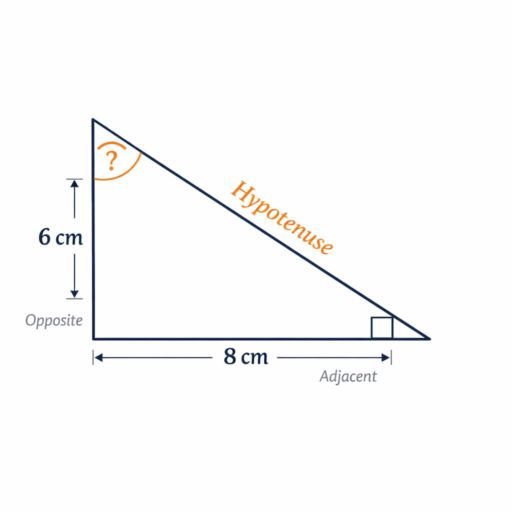
Fig 1: Labelling the triangle correctly is always the first step — before any formula is applied. Replace this placeholder with your hosted diagram image.
📖 Step-by-Step Solution
In this problem, that is the top-left angle. Label it clearly on the diagram before doing anything else.
The 6 cm side is directly across from the top-left angle — the opposite. The 8 cm side touches the angle without being the hypotenuse — the adjacent.
Because we know the opposite and the adjacent — not the hypotenuse — only tangent connects exactly these two sides.
Tan(angle) = 6 ÷ 8
Tan(angle) = 0.75
Use the calculator's inverse tangent key, usually shown as tan⁻¹.
angle = 36.9° (to 1 decimal place)
Common Obstacles Children Face — And What Parents Can Do About Them
Trigonometry rewards precision and punishes shortcuts. Knowing exactly where students typically go wrong lets parents intervene early.
⚠️ Mislabelling Opposite and Adjacent
Students chant "SOH CAH TOA" but apply it to the wrong sides.
⚠️ Forgetting the Inverse Function
Students compute a ratio but forget to apply sin⁻¹, cos⁻¹, or tan⁻¹.
⚠️ Wrong Rule for Oblique Triangles
Students default to SOH CAH TOA even when there's no right angle.
⚠️ Calculator Mode Errors
Calculators set to "radians" instead of "degrees" produce plausible-looking wrong answers.
How Singapore's Curriculum Builds Trigonometric Fluency
Singapore builds trigonometry as a natural extension of geometry and ratio, using the Concrete–Pictorial–Abstract (CPA) approach that underpins the national syllabus.
Concrete: Physical Similar Triangles
Students cut out and compare similar right-angled triangles, measuring sides to discover that ratios stay constant.
Pictorial: Labelling and Diagrams
Students redraw and label every triangle — right angle, reference angle, hypotenuse, opposite, adjacent — before calculating.
Abstract: The Ratio Formulas
SOH CAH TOA and the sine/cosine rules are introduced as formal tools for a relationship already discovered hands-on.
Application: Multi-Step Word Problems
Students progress to problems on elevation, bearings, and combined shapes — mirroring real exam structures.
Spiral Revisit: Secondary Extension
The topic resurfaces from Sec 1 to Sec 3, extending into 3D trigonometry and bearings.
How Trigonometry Shows Up in the Real World
Trigonometry rarely announces itself — but it works silently behind almost every measurement of height, distance, and direction we take for granted.
🏗️ Construction & Architecture
Architects use trigonometry to calculate roof pitches, staircase angles, and load angles before a single brick is laid.
📡 GPS & Satellite Navigation
GPS receivers calculate your location by measuring signal angles and distances from multiple satellites.
✈️ Aviation & Navigation
Pilots calculate flight paths, descent angles, and wind correction angles using trigonometric ratios.
🔭 Astronomy
Astronomers use parallax — a giant triangle between Earth and a star — with trigonometry to measure cosmic distances.
🗺️ Surveying & Land Mapping
Surveyors used triangulation to map coastlines and countries, including early surveys of Singapore.
🎮 Technology & Gaming
Every rotation and camera angle in a 3D video game is calculated using trigonometric functions.
Start Today: Your Child's Trigonometry Journey Begins at Home
Ask one simple question next time you see a ladder leaning against a wall: "What angle do you think that is?"
🎯 Your Action Plan This Week
- Print a SOH CAH TOA reference card — with a labelled right-angled triangle. Stick it above the study desk.
- Build a physical similar-triangles set — cut two triangles of different sizes but identical angles, and measure ratios by hand.
- Measure a real shadow — use height and shadow length with the tangent ratio to estimate the sun's angle of elevation.
- Practise inverse functions explicitly — give a ratio like 0.6 and find the angle using tan⁻¹, sin⁻¹, and cos⁻¹.
- Work through the worked example above together, then reverse it — give the angle and one side, find the missing side.